
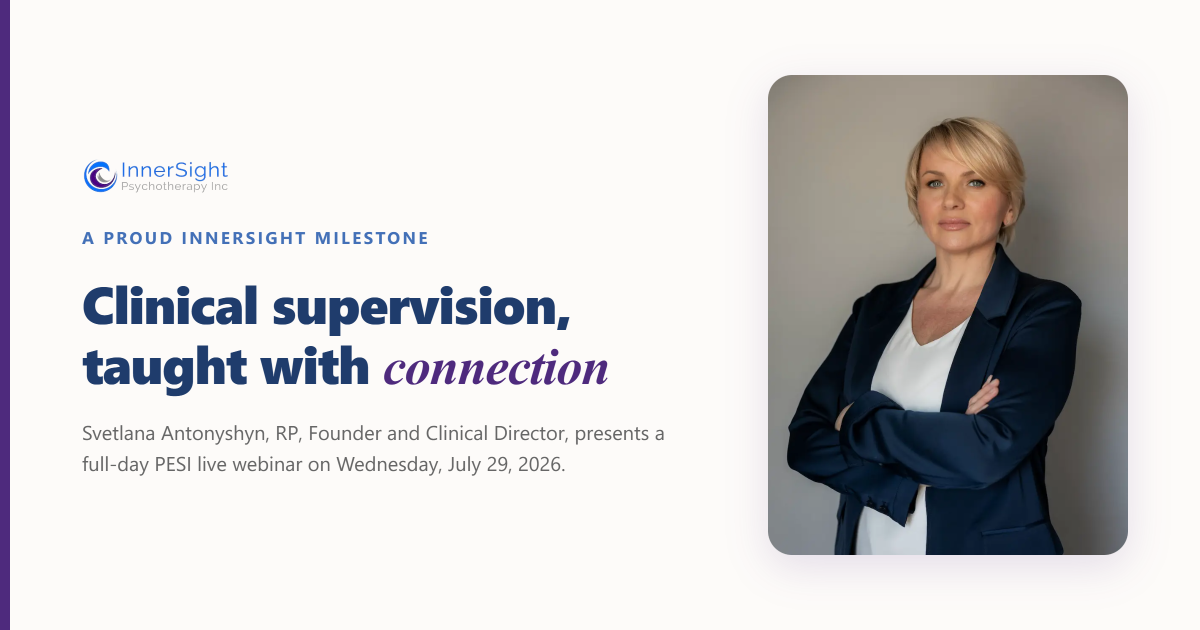
We have some news we’re genuinely proud of, and it’s the kind of news that says something bigger about the care you receive here.
On Wednesday, July 29, 2026, our founder and Clinical Director, Svetlana Antonyshyn, RP, will present a full-day live webinar for PESI: “Clinical Supervision Intensive Training: Applying Polyvagal and Attachment-Based Tools to Lead with Competence and Connection.” PESI is one of the largest continuing education providers in behavioural health in North America, the same organization whose faculty has included some of the most recognized names in trauma and psychotherapy education. Clinicians from across the continent will spend the day learning how to supervise other therapists, and they’ll be learning it from the person who built InnerSight around that exact craft.
If you’re a therapist or clinical supervisor, you can register for the webinar through PESI.
But this post isn’t really about the webinar. It’s about the question behind it, one most therapy clients never think to ask: who is taking care of your therapist’s growth?
The Invisible Layer Behind Good Therapy
When you look for a therapist, you probably think about credentials, specializations, personality fit, maybe reviews. What almost nobody asks is: does this therapist practise alone, or do they have structured, ongoing support behind them?
That support is called clinical supervision. It’s a formal, regulated practice in which a therapist meets regularly with a more experienced clinician to review their work, reflect on what’s happening in their sessions, examine their own reactions and blind spots, and continue sharpening their skills. It is not a performance review and it’s not remedial. It’s how the profession ensures that the person sitting across from you keeps growing for as long as they practise.
In Ontario, supervision isn’t optional for developing therapists. The College of Registered Psychotherapists of Ontario (CRPO), which regulates our profession, requires new Registered Psychotherapists to complete 1,000 hours of direct client work and 150 hours of clinical supervision before they can practise independently. And as of April 2026, anyone who begins providing clinical supervision must first complete dedicated training in how to supervise. The province treats supervision as a discipline in its own right, because it is one.
At InnerSight, we’ve gone further than the minimum since the day we opened. Every therapist here, regardless of experience level, takes part in monthly supervision and skills development. Nobody practises in isolation. That has been our core quality commitment from the beginning, and it’s described in more detail in our approach.
Why Svetlana Was Asked to Teach This
Svetlana founded InnerSight after a devastating personal loss, with a mission to build the kind of clinic she couldn’t find: one where family doctors could refer with confidence, and where clients could heal without being reduced to a diagnosis. Her answer to the quality problem was mentorship. She built a model where interns train under close guidance, therapists are supervised throughout their careers, and quality is a structure rather than a slogan.
That model has now developed more than 25 fully qualified therapists across Ontario. It draws on the same frameworks our clinicians use with clients: attachment theory, which explains how safety in relationships shapes learning and growth, and Polyvagal-informed practice, which looks at how the nervous system responds to safety and threat. Her insight is that supervision works the same way therapy does. A supervisee who feels safe, seen, and supported learns faster and practises more courageously than one who feels evaluated and judged. She calls this the science of safety in supervision, and it’s the framework she’ll be teaching clinicians across North America on July 29.
For a national continuing education body to invite a clinic founder to train other supervisors is a meaningful recognition. We think it’s worth pausing on, not for the sake of a trophy shelf, but because of what it means for you.
What the Research Says (Honestly)
We hold ourselves to a standard of honesty about evidence, so here’s the straightforward version.
Research on clinical supervision consistently shows that it strengthens therapists: supervised clinicians demonstrate greater competence and build stronger therapeutic alliances with their clients. That second part matters enormously, because decades of psychotherapy research point to the quality of the relationship between client and therapist as one of the most reliable predictors of good outcomes. When supervision strengthens your therapist’s ability to build that relationship, it’s strengthening the single most important ingredient in your therapy.
The research on supervision’s direct, measurable effect on client symptoms is younger and more modest; recent reviews describe a positive but small-to-medium effect that researchers are still working to pin down. We won’t claim supervision is a magic multiplier, because that’s not what the evidence says. What it clearly is: the profession’s most important quality assurance and safety mechanism, the reason regulators require it, and the difference between a therapist who grows for thirty years and one who plateaus after three.
What This Means When You Sit Down With an InnerSight Therapist
Here’s the practical translation. When you work with any of our 25+ therapists, you’re never really working with just one person. Behind your therapist is a structure: monthly supervision, ongoing skills development, and a clinical director who is now literally training the next generation of supervisors across the continent.
If your therapist encounters something complex in your work together, they have somewhere to take it. If a particular approach isn’t landing, they have experienced eyes helping them adjust. Your care benefits from collective experience, not just individual effort.
And because your privacy matters: supervision happens within the profession’s strict confidentiality framework. Therapists consult on their clinical work in ways that protect your identity and personal information. The purpose is always better care for you, never exposure of you.
If you’ve been thinking about starting therapy and wondering what actually happens behind the scenes, our post on what to expect from your first therapy session walks through the experience step by step.
Frequently Asked Questions About Clinical Supervision
What is clinical supervision in psychotherapy?
Clinical supervision is a structured, ongoing professional relationship in which a therapist regularly reviews their clinical work with a more experienced clinician. It supports skill development, ethical practice, and self-awareness, and it’s a regulated requirement for developing therapists in Ontario under the CRPO.
Does my therapist being supervised mean they’re inexperienced?
No. Supervision is required for newer therapists in Ontario, but at InnerSight every therapist participates in monthly supervision regardless of experience level. The best clinicians treat supervision the way elite athletes treat coaching: something you never outgrow.
Is my personal information shared in supervision?
Your privacy is protected. Supervision is a professional consultation governed by the same confidentiality standards as therapy itself. Therapists discuss clinical work in ways that safeguard your identity, and the entire purpose is to improve the care you receive.
How does supervision benefit me as a client?
Supervision strengthens the two things research links most strongly to good therapy outcomes: your therapist’s competence and the quality of your therapeutic relationship. It also means complex situations in your therapy get more than one experienced perspective.
Who is Svetlana Antonyshyn?
Svetlana Antonyshyn is a Registered Psychotherapist and the founder and Clinical Director of InnerSight Psychotherapy. She built InnerSight on a mentorship and supervision model that has developed more than 25 qualified therapists, and she specializes in attachment-based and Polyvagal-informed psychotherapy.
I’m a therapist. How do I attend the webinar?
The full-day live webinar runs Wednesday, July 29, 2026 and is hosted by PESI, with continuing education credits available. You can find details and registration on the PESI event page.
The Standard Behind “Believe in Better”
Our tagline is a promise about your future, but it’s also a promise about our own. Believing in better means never deciding we’re finished learning. It means building structures that keep every therapist here growing, and it means being genuinely proud, this month especially, of where that commitment has led.
If you’d like to experience what supervised, quality-assured therapy feels like, we offer a free 20-minute consultation. You can ask questions, share what’s on your mind, and get matched with the right therapist for your needs.
We’re in Vaughan, Woodbridge, and Barrie, with online sessions available across Ontario. Evening and weekend appointments are available.
Book your free consultation or call (905) 553-9507.
Believe in better. We do, every single day.