
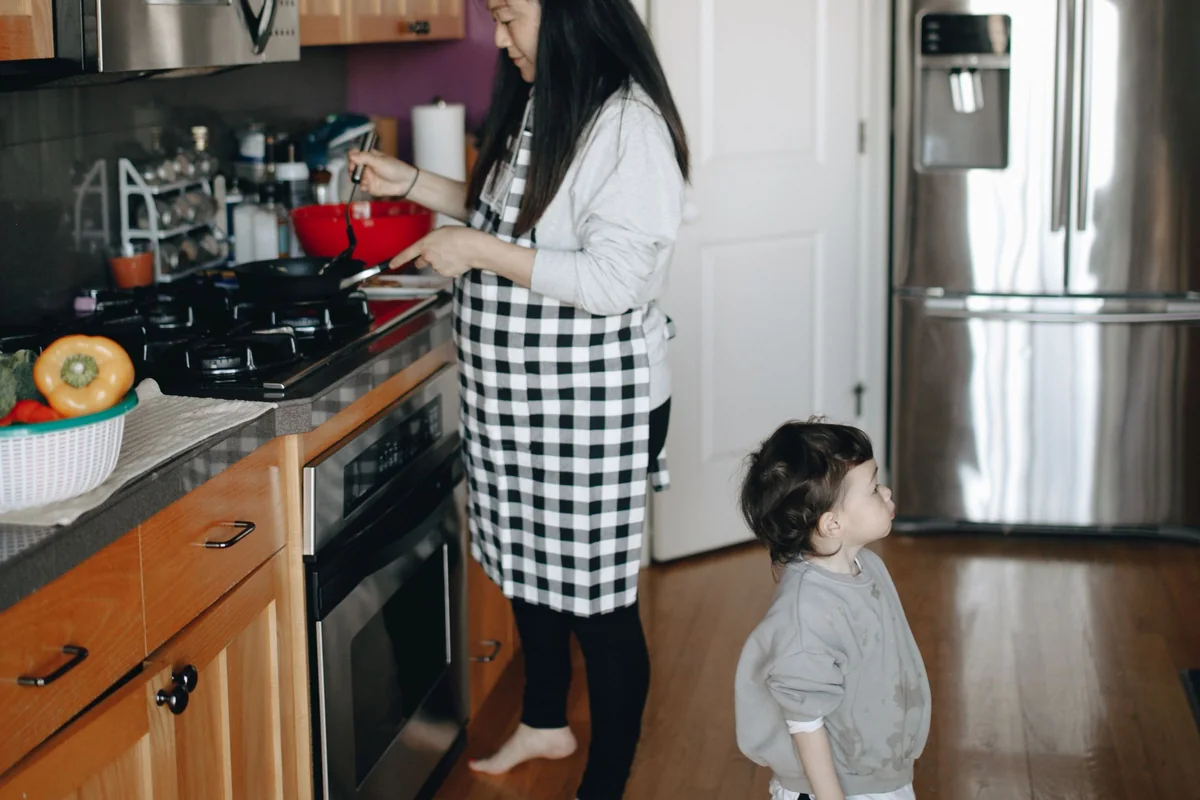

It is a quarter past six. Dinner is twenty minutes from being ready, the homework folder is still in the car, and you have asked the same child the same question three times in a tone that got worse each time.
The fourth time, you snap. Not dramatically. You are not throwing anything. But your voice does something you did not choose, and you watch your kid's face change, and you feel the whole thing land.
Then comes the part nobody talks about, which is the hour afterward, lying in the dark composing evidence against yourself.
Parental anger is one of the most common things we are asked about and one of the least often said out loud.
Anger is a capacity problem before it is a character problem
Most parents interpret the snap as information about who they are. A more patient person would not have done that. A better parent would have held it together.
The research on parental burnout points somewhere else entirely. Working with 923 parents across a two-wave longitudinal study, Moïra Mikolajczak and Isabelle Roskam found that burnout in parents arises from a chronic imbalance of risks over resources. Not from insufficient love, not from a character flaw, and not from any one stressor. From a ledger that has been running a deficit for a long time.
Their wider body of work describes a sequence that matters here. Exhaustion tends to come first. Emotional distancing from your own child follows it. Which means that going flat, short-fused, or robotic with a kid you adore is not the beginning of a moral decline. It is a predictable downstream effect of running on empty for months.
That reframe is worth more than it first appears. A character problem has no obvious intervention except trying harder, which is exactly what an exhausted person has no more of. A capacity problem has a dozen.
Why six in the evening specifically
There is nothing mysterious about the hour. It is where four things arrive at once.
You are at the end of your own regulating capacity, having spent the working day being reasonable at people. Your children are at the end of theirs, having held it together at school all day, which is precisely why they fall apart at home and not there. The tasks are non-negotiable and time-bound. And nobody in the house has eaten.
Understanding that does not dissolve the problem, but it changes where you aim. Most parents try to fix six o'clock at six o'clock, which is the one hour it cannot be fixed in. What can be changed sits almost always earlier in the day, or earlier in the week.
The shame spiral does more damage than the snap
This is the part that keeps people stuck, and it is worth separating out.
Guilt says: I did something I do not want to do again. It is uncomfortable, it points at a behaviour, and it tends to produce change. Shame says: I am the kind of person who does that. It points at you rather than the action, and it produces hiding.
Hiding is the expensive part. A parent deep in shame does not tell their partner what happened, does not mention it to friends who would say me too, and does not raise it with a professional because saying it out loud feels like inviting judgment. So the isolation grows, the resources side of the ledger shrinks further, and the next six o'clock is harder than the last.
What actually protects children is repair
Edward Tronick spent decades filming parents and infants interacting, and the finding that came out of it is the most useful thing a struggling parent can hear.
Ordinary, healthy parent and child interaction is full of mismatches. The parent misreads the signal, the child protests, the connection breaks and is then repaired, over and over, all day long. Tronick's argument is that those cycles are not failures of parenting that a better parent would avoid. The repair is where the developmental work happens. A child who experiences rupture followed reliably by repair learns something a child in a frictionless relationship never gets to learn, which is that connection survives things going wrong.
So the goal was never the parent who does not lose it. That parent does not exist, and children raised by someone anxiously preventing every rupture do not come out more resilient. The goal is the parent who comes back.
What a repair sounds like
Short. Specific. Without a clause that hands the blame back.
I shouted at you before, and that was not okay. You were not doing anything wrong, I was tired and I took it out on you. I am sorry.
What undoes it is the addition most of us reach for automatically: but you had been ignoring me for ten minutes. That turns an apology into a case for the prosecution, and children hear the second half.
Repair also works late. If you are reading this about something from last week, or last year, it still counts.
What you can actually change
If six o'clock cannot be fixed at six o'clock, the practical question is what can be moved somewhere earlier.
Some of it is unromantic logistics. Every decision removed from that hour is capacity returned to it, which is why the families who seem to have it together are usually not calmer people, they have simply front-loaded the work. Food decided the night before. Bags by the door. The homework conversation moved to a time when nobody is hungry.
Some of it is expectation. A great deal of six o'clock rage is really a collision between what the hour was supposed to look like and what it can realistically be with these particular children at these particular ages. Lowering the target is not giving up. It removes the gap that the anger is generated in.
And some of it is the resources column, which is the part parents skip because it feels indulgent. Sleep, food, one thing in the week that belongs to you, an adult who knows how it is actually going. The burnout framework does not treat those as indulgences. They are the other half of the ledger, and a ledger cannot be balanced by cutting the risks alone.
When it is worth getting help
Some version of this happens in every household and most of it is ordinary. A few signs suggest it is worth talking to someone rather than waiting for a quieter season.
The frequency is climbing rather than holding steady. You are frightening yourself with the intensity, or with how fast zero goes to sixty. Your child has started managing you, going quiet or watchful around your mood, which is worth taking seriously and is sometimes a reason to get support for them as well as for you. You have gone numb rather than angry, which the burnout research suggests is the later stage and not the recovery. Or it is bleeding outward into your work and into your relationship, which is its own reason to consider couples therapy.
One thing that needs saying plainly rather than hinted at. If anger in your home has become physical, or you are afraid it might, that needs help now rather than eventually, and there is no version of this article that is a substitute for that. If anyone is in immediate danger, call 911.
What therapy does with this
Very little of it is anger management in the way people imagine, which is to say counting to ten while furious. Counting to ten at six o'clock is a last line of defence and by then most of the work is already lost.
More of it is spent on the ledger. Where the load actually sits and what could realistically come off it. What happens in your body in the ninety seconds before the snap, since almost everyone has a reliable early signal they have never been shown how to notice, which is the core of emotion management work. What you learned about anger in the house you grew up in, because a striking number of parents are either repeating something or working so hard to avoid repeating it that they swing to the other extreme. And how to repair without collapsing into apology, which is its own trap.
We offer anger management therapy and parenting counselling in Woodbridge, Vaughan, Barrie and online across Ontario. Both are ordinary, unglamorous work, and both are private and confidential.
If the hour before dinner has become the worst part of your day, that is a reasonable thing to bring to a free 20-minute consultation. Wanting to be different with your kids is rarely evidence that you are failing them. More often it is the thing that changes it.