
Muslim therapist in Vaughan, without leaving half of yourself at the door
Some of what you are carrying is not only emotional. It touches your family, your culture and your faith, and the worry about being misread has probably kept you from booking anything. Faith-informed therapy means your beliefs are welcome in the room and stay entirely yours.
No referral needed · in-person or online · with Registered Psychotherapists.
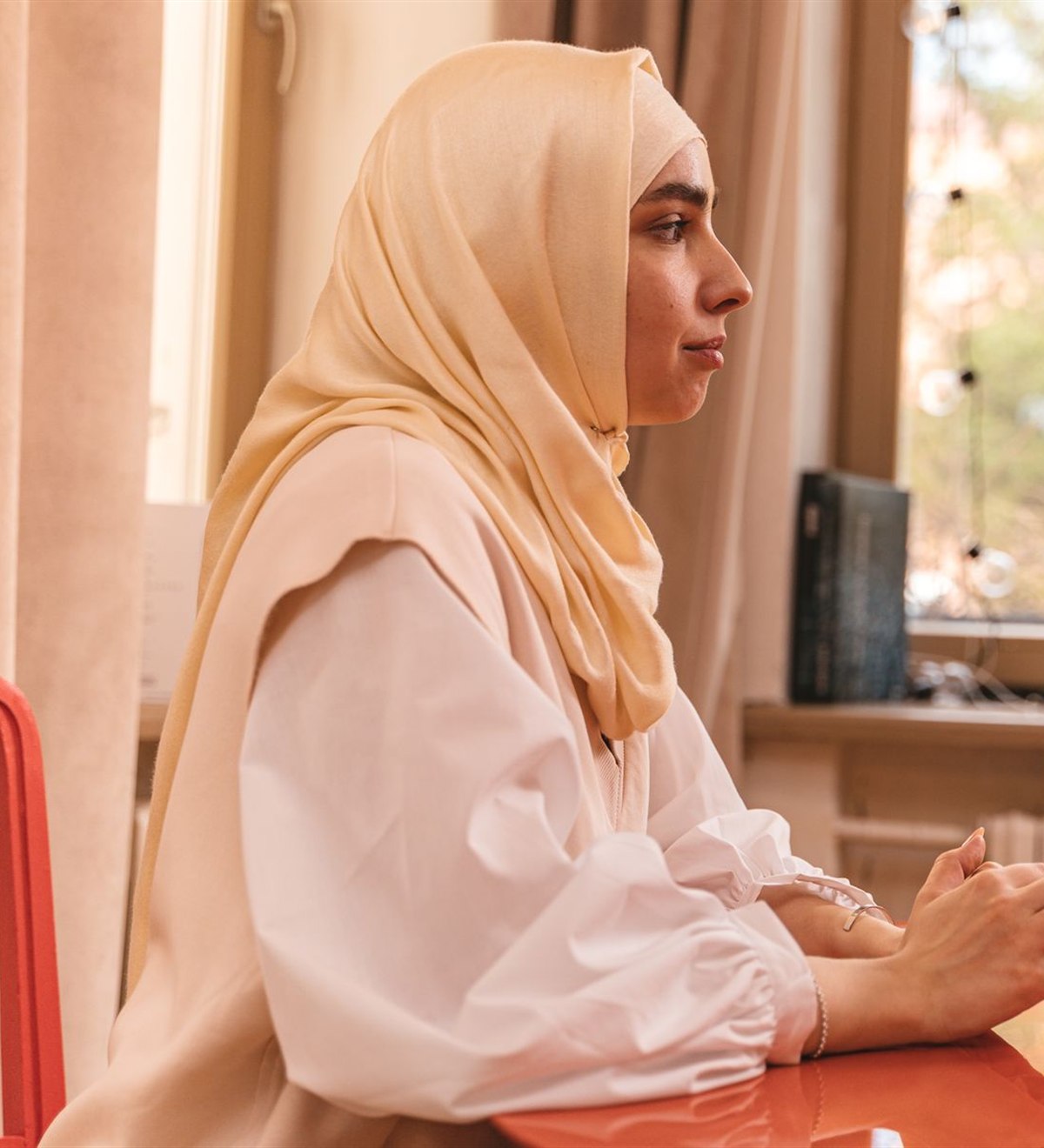
Psychotherapists
supervision
only if you want it
20 minutes
Clinically reviewed by Svetlana Antonyshyn, Registered Psychotherapist (CRPO #001652). Last reviewed August 2026.
What does it mean to work with a Muslim therapist in Vaughan?
Faith-informed therapy is standard, evidence-based psychotherapy delivered by a therapist who works with your religious and cultural context rather than around it. Your faith is brought in only when you want it. At InnerSight it is offered by Zainab Mahdi, a Registered Psychotherapist, online across Ontario, at $180 for 55 minutes.
It means ordinary, evidence-based psychotherapy, delivered by someone who does not need the background explained to them. The methods are the ones used everywhere else at this clinic: cognitive behavioural therapy, acceptance and commitment therapy, mindfulness-based work, solution-focused work. What changes is the context they are applied in, and how much explaining you have to do before the work can start.
Faith comes into it only if you want it there. For some people that means prayer and patience are named as the resources they already are, and built on. For others it means an hour a week where religion is simply not the subject, because the problem is a manager, or a marriage, or a panic attack on the 407. Both are legitimate. Your therapist follows your lead rather than assuming that faith is either the whole story or beside the point.
The research on this is more interesting than the marketing usually admits. Adapting therapy to someone’s religion does not appear to make it better at reducing distress than good ordinary therapy. It appears to make it equally effective, while doing more for spiritual wellbeing, and to be moderately more effective for people whose faith is central to their lives. The practical case is not that this works better. It is that people who cannot find it often do not come at all, or leave early.
That is the finding worth knowing. When Ontario researchers ran fifteen focus groups with Muslim service users and providers in 2025, the barrier people named was not the therapy. It was the shortage of culturally and religiously informed care, and the tiredness of having to educate your own therapist about your own life before getting to the reason you came.
Who is the Muslim therapist you would be working with?
Zainab Mahdi is a Registered Psychotherapist, CRPO 009758, and a practicing Muslim herself. This is a stated specialism rather than a line added to a profile: in her own words, she has a special interest in supporting Muslim individuals and families looking for therapy that respects and works with their faith, cultural identity and lived experiences.
She works with adults, couples and families on anxiety, depression, relationship difficulties, life transitions, grief and trauma, drawing on cognitive behavioural therapy, acceptance and commitment therapy, mindfulness-based and solution-focused work. Sharing a faith is not the same as holding religious authority, and she would say so herself. What it means in practice is narrower and more useful: you can use the words you already use, and skip the preamble.
She sees clients online across Ontario, so distance is not the deciding factor, and her registration can be checked on the College’s public register in about a minute.
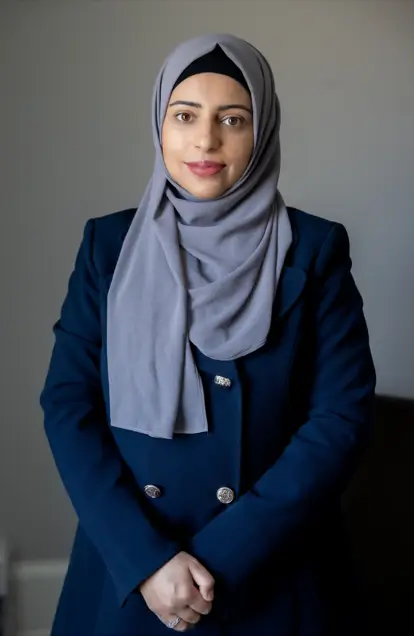
Zainab Mahdi
What people expect, and what actually happens
These are the three worries that come up most often before a first appointment. Each one is reasonable. Here is what the session is actually like.
My therapist will decide my faith is the problem, or treat my practice as something to be talked out of.
Your beliefs are not the material being treated. A therapist works on what you came in with, whether that is anxiety, a marriage or a loss. Where your faith is a source of steadiness, it stays a resource. Where you are wrestling with it, that is yours to wrestle with, and the room is a place to think out loud rather than be corrected.
You are part of a large and growing community
What people bring to faith-informed therapy
You have not told anyone in your family or community what you are dealing with, because you are not sure how it would be received and you do not want to become the subject of a conversation. That silence is often heavier than the original problem.
What your parents expect and what your life in Canada looks like do not line up, and you have been managing that gap quietly for years. Career, marriage, how you dress, how often you visit, what you owe people.
The worry is bad enough on its own, and then comes the thought that a person with real faith would not feel this way. Two problems where there was one.
Conflict with a spouse, in-laws with opinions, or a family decision being made for you rather than with you. You want to work on it without the whole thing becoming public.
You were told to be patient, that it was decreed, that this is a test. All of that may be true and you may believe it, and you are still not sleeping four months later.
Your children are growing up with a set of references you did not have, and the parenting advice available to you assumes a family that does not look like yours.
Something happened, and the reasons you have not spoken about it include shame, family, and not knowing whether you would be believed. Trauma work moves at whatever pace you set.
Does therapy that engages with faith actually work better?
Therapy that engages with your faith is at least as effective as standard therapy, and better for spiritual wellbeing. What Ontario research finds is that the barrier is not therapy itself but the shortage of clinicians who already understand your background.
people across 97 outcome studies. Therapy adapted to a client’s religion and spirituality worked as well as standard therapy at reducing distress, and did better on spiritual wellbeing.
Captari, Hook, Hoyt, Davis, McElroy-Heltzel and Worthington, Journal of Clinical Psychology, 2018
of people in Canada are Muslim, 1,775,715 at the 2021 Census, more than double the 2.0 percent recorded in 2001.
Statistics Canada, The Muslim population in Canada, 2021 Census, 2024
randomized trials pooled. For people with a strong religious or spiritual affiliation, therapy that engages with that affiliation outperformed standard treatment on symptoms.
randomized trials of religiously adapted CBT. Clearly better than no treatment.
It could not settle whether it beats ordinary CBT head to head.
de Abreu Costa and Moreira-Almeida, Journal of Religion and Health, 2021
focus groups with Muslim service users and providers in Ontario. The barrier was not therapy itself but the shortage of culturally and religiously informed care, and the strain of having to educate your own therapist.
Faruk, Asadullah and Tsang, Journal of Community Psychology 53(7), 2025
What do the first few sessions look like?
The first conversation is free and it is a conversation, not an intake form. Bring the questions you would rather not ask in front of anyone.
A Registered Psychotherapist is not an imam, a sheikh or a scholar, and this page is not religious guidance. Nobody here will tell you what is permitted, interpret scripture for you, or answer a question that belongs to someone with religious training.
A free 20-minute consultation
You describe what is going on in whatever language you use for it. This is also the place to ask the awkward questions: how much religion is going to come into this, who has access to your file, and whether your therapist has worked with people from your background before. Ask them. A good answer costs you nothing and a bad one saves you months.
The first full session, and setting the terms
Sessions run 55 minutes at $180, and the first is a 70-minute assessment at $245. Early on you decide together how faith sits in the work: front and centre, occasionally relevant, or out of scope entirely. That is a setting you can change at any point, and changing it does not require a reason.
The work itself, and how you know it is moving
From there it is ordinary therapy on whatever you came for. Progress shows up in things you can check: whether you slept, whether the Sunday phone call went differently, whether you said the thing you have been rehearsing for a year. If nothing has shifted after a fair stretch, that is a reason to change approach, and your therapist should raise it before you do.
How does a Muslim therapist actually work with faith in the room?
Where prayer, community or a sense of purpose already steady you, the work builds on them rather than treating them as symptoms to be examined. Where you are in a difficult place with your faith, that is yours to work out, and the room is somewhere to think aloud without being corrected or reassured too quickly.
Cognitive behavioural therapy, acceptance and commitment therapy, mindfulness-based and solution-focused work, the same evidence-based approaches used across this clinic. The adaptation is in the framing and the examples, not in swapping evidence-based methods for something untested.
Family is often central rather than peripheral, and that is treated as ordinary rather than as a problem to be solved by distance. Sometimes the work is a boundary. Sometimes it is a conversation you have been avoiding. Nobody will push you toward cutting people off as though that were the obvious healthy answer.
A Registered Psychotherapist is not an imam, a sheikh or a scholar, and nothing here is a religious ruling. If the question you are carrying is a religious one, you want someone with religious training, and plenty of people see both. Our therapists also do not diagnose or prescribe, and work alongside your family doctor.
What therapy costs in Vaughan
No hidden fees. Most private insurance plans cover a portion of psychotherapy fees.
Twenty minutes by phone or video. Tell us what is going on, ask anything, and see if it feels right. No obligation.
Your first appointment is a 70-minute assessment at $245. Most private insurance plans cover a portion.
Available if you later want to bring a partner or family member into the work.
Reduced-fee sessions from $125 are available with select supervised therapists in training through our affordable therapy program.
Your questions, answered
What is faith-informed therapy, and what happens in a session?
It is ordinary evidence-based psychotherapy with your religious and cultural context already understood rather than explained from scratch. A session looks like any other therapy session: you talk about what is going on, your therapist helps you see the pattern, and you leave with something to work on. The difference is that references to prayer, fasting, family obligation or community expectation do not need translating, and that your beliefs are treated as part of who you are rather than material to be examined.
Do I have to talk about religion in therapy?
No, and plenty of people do not. Faith-informed means the option is available and welcome, not that it is the agenda. Some people want their faith woven through the work. Others want an hour a week where the subject is a difficult manager and nothing else. You set that, you can change it at any session, and you never have to justify the setting you choose.
Will my therapist actually understand my background?
Zainab is a practicing Muslim herself, and names supporting Muslim individuals and families as a specialism on her own profile, so you are not starting from nothing. What she will not do is assume your practice or your family looks like anyone else’s, because Muslim communities in Ontario vary enormously in culture, language, school of thought and how central faith is day to day. A shared faith is a starting point rather than a shortcut, so expect to be asked about your particular life. Ask her directly at the free consultation; it is a fair question and she will not be offended by it.
Is going to therapy in conflict with my faith?
That is a religious question, and a Registered Psychotherapist is not the person to answer it. Zainab is a practicing Muslim, and that still does not make her a scholar: being able to understand the question is not the same as being qualified to rule on it. Nobody here will issue a ruling, and you should be wary of any therapist who does. What we can tell you is what therapy asks of you, which is not that you set aside your beliefs, change your practice, or accept a particular view of the world. If you want the religious question answered properly, speak to someone with religious training. A good number of people do both, and find they are answering different questions.
Is what I say confidential, and could it reach my family?
What you say is private and confidential. Registered Psychotherapists are regulated by the College of Registered Psychotherapists of Ontario and bound by Ontario’s health privacy law. Your family is not told that you attend, and nothing is shared with them without your written consent, including for adults who live at home. There are narrow legal exceptions, such as a risk of serious harm to you or someone else, and your therapist will set those out specifically in your first session rather than leave you to wonder.
What is the difference between seeing a therapist and speaking to my imam?
They answer different questions and they are not in competition. An imam can speak to religious meaning, obligation and what your faith asks of you, which a therapist cannot and should not. A therapist works on how your mind and body are actually functioning: the sleep, the panic, the pattern in the marriage, the grief that has not moved. Many people find that the community support and the clinical work sit alongside each other, and that neither one substitutes for the other.
Can we come as a couple or as a family?
Yes. Zainab works with couples and families as well as individuals, which matters when the difficulty is a marriage, an in-law relationship or a decision being made about you rather than with you. Couples and family appointments are $280 for 85 minutes, and the first runs 90 minutes at that rate. Some people start individually and bring a spouse in later, and that is a normal way to do it rather than a sign anything has gone wrong.
How much does it cost, and will my insurance cover it?
An individual session is $180 for 55 minutes, the first appointment is a 70-minute assessment at $245, and the 20-minute consultation is free. Psychotherapy is not covered by OHIP. Most extended health plans cover a portion when the therapist is a Registered Psychotherapist, so look on your plan for a psychotherapy line and an annual maximum. We bill Sun Life, SSQ and Green Shield directly. Reduced-fee sessions are available with select supervised therapists in training.
More from our therapists

Leaving for University: The Transition Nobody Prepares You For
Every August, minivans across the GTA fill up with mattress toppers, power bars, and a teenager pretending to be less nervous than…
Read article →
Summer Burnout Is Real: Why Chasing the Perfect Summer Is Exhausting You
Somewhere around mid-July, a strange kind of tiredness sets in. Not the satisfying tiredness of a day at the beach. The other…
Read article →
Why Men Don't Talk About It: Men's Mental Health and How Therapy Actually Helps
June is Men's Mental Health Month, and with Father's Day on June 21, it's a month that celebrates men while also quietly…
Read article →Where to see us in person, or meet online
Three offices across Vaughan and Barrie, plus secure video sessions anywhere in Ontario. Evenings and weekends available.
Three steps, starting today
Book your free consult
Online in 2 minutes or by phone. No referral, no credit card.
Meet your therapist
Talk it through and get matched with the right fit for you.
Move at your own pace
Decide how much of your faith belongs in the work, and change that whenever you want to.